A Persian handmade rug is far more than an ordinary floor covering. A fine Persian rug is the result of carefully selected raw materials, design expertise, dyeing knowledge, thousands or sometimes millions of hand-tied knots, and months or even years of skilled work.
For that reason, the care and washing of a Persian handmade rug should never be approached in the same way as the cleaning of a machine-made rug, fitted carpet, or synthetic floor covering.
One of the questions buyers frequently ask us at Persian Royal Rug is:
If a Persian handmade rug becomes dirty, how should it be cleaned or washed?
That question is usually followed by several others:
Should a Persian handmade rug be washed every year?
Can a Persian wool rug be washed at home?
What should be done if tea, coffee, or another drink is spilled on the rug?
After washing, how should the rug be dewatered and dried?
And can a fine Qom silk rug be washed in the same way as a wool rug?
Before answering these questions, one principle is more important than any washing instruction:
The best way to care for a Persian handmade rug is to maintain it so well that full washing is needed as infrequently as reasonably possible.
Treat a Persian Handmade Rug as a Luxury Object
A simple comparison helps explain the idea.
An owner of a Lamborghini or Bugatti normally does not treat the car like an ordinary vehicle. The reason is not merely its price. The owner understands that it is a product of high-quality materials, design, engineering, specialist labor, and countless hours of work, and its maintenance should reflect that value.
The same logic applies to a fine Persian handmade rug.
Thousands of hours of human work may be invested in a single rug. The quality of the wool or silk, the dyeing, the design, the number and fineness of the knots, the finishing, and the experience of the weaver all contribute to an object that can outlast many ordinary household furnishings.
Therefore, my first recommendation to the owner of a Persian handmade rug is not to search for the strongest cleaning product available.
It is this:
As far as possible, do not allow the rug to reach a condition in which aggressive or unnecessarily frequent washing becomes necessary.
Care first, washing only when needed.
Prevention Matters More Than Frequent Washing
When a Persian wool rug is used as a luxury floor covering, its location and the way it is used directly affect how often deeper cleaning may be required.
Soil and grit carried in on outdoor shoes, household dust, food, beverages, grease, and prolonged moisture can all shorten the interval between professional or full cleanings.
A few simple habits can materially extend the useful life of the rug.
Avoid walking on a fine Persian handmade rug with dirty outdoor shoes whenever practical. Remove loose dust regularly and gently. If liquid is spilled, do not leave it sitting in the pile. Do not allow the rug to remain in a damp environment for a prolonged period.
Dust is not only a cosmetic issue. Fine particles can work down into the pile and foundation, where repeated foot traffic may cause abrasion over time. Regular, controlled dust removal is therefore part of preventive conservation as well as ordinary housekeeping.
This does not mean that a rug should not be used.
A well-made Persian wool rug is made to be lived with.
The point is to use it in a way that respects its material and artistic value.
Does a Persian Handmade Rug Need to Be Washed Every Year?
Not necessarily.
There is no universal rule requiring every Persian handmade rug to be washed once a year.
The correct interval depends on the actual condition of the rug rather than the calendar.
A rug in a busy living room may need deeper cleaning sooner than one displayed in a guest room or another low-traffic area. Conversely, if a rug has been well maintained, regularly dusted, and has no significant staining or soil accumulation, the mere passage of twelve months is not a reason to saturate it with water.
Full washing involves wetting the rug, handling it in a heavier and more vulnerable state, rinsing it, removing excess water, moving it again, and drying it completely.
Instead of asking:
“Has one year passed since the last wash?”
ask:
“Does this Persian handmade rug actually need washing in its present condition?”
How Can You Tell When a Rug Really Needs Washing?
Appearance is one indicator, but not the only one.
Noticeable dullness, substantial embedded dust, generalized soiling, multiple stains, or a persistent odor may indicate that deeper cleaning should be considered.
However, if only one small area is affected, the entire rug does not automatically need to be soaked. A limited problem may sometimes be addressed with careful spot cleaning.
A useful principle for Persian rugs is:
If a gentler method solves the problem safely, do not escalate to a harsher one.
Why Wool Quality and Dyeing Matter
The long-term performance of a Persian handmade rug begins with its raw materials.
In a high-quality Persian wool rug, good wool is an important part of durability, appearance, handle, and long-term performance. Where a rug is made with natural dyes, properly executed natural dyeing is also part of its traditional character and quality.
High-grade wool can be remarkably durable when correctly maintained.
But “high quality” does not mean “indestructible.”
Even an exceptional Persian handmade rug can be harmed by chlorine bleach, strong acids or alkalis, unsuitable solvents, prolonged dampness, rough mechanical treatment, or an inappropriate washing method.
Conversely, a well-made rug that is used and maintained intelligently can have an exceptionally long service life.
The survival of historic Persian carpets across generations demonstrates that high-quality handwoven textiles can endure for very long periods under favorable conditions.
A Persian handmade rug should therefore not be regarded as a short-lived disposable furnishing.
What Should You Do If Tea or Coffee Spills on a Persian Rug?
Tea and coffee spills are ordinary household accidents.
If a cup of tea or coffee is spilled on a Persian wool rug, it does not automatically mean the rug has been ruined.
The initial response matters most.
First, use a clean, white, absorbent cloth to blot and absorb as much liquid as possible.
Blot the liquid; do not aggressively rub the stain.
Hard rubbing can push the liquid deeper into the pile, distort the surface, and enlarge the affected area.
For a sound Persian wool rug with stable dyes, a small amount of water and a very mild cleaning agent may be suitable for some common household spills after the excess liquid has been absorbed.
However, if you do not know whether the colors are stable, take a more conservative approach.
A Drink Spill Is Not Always a Disaster
Many owners see tea, coffee, or another beverage on a rug and immediately assume that irreversible damage has occurred.
In many cases, that is not true.
Common beverage spills can often be managed if action is prompt and appropriate. But beverages differ: sugar, coloring agents, acidity, milk, and other additives can change the nature of the stain.
The first step remains rapid absorption of excess liquid.
If, during spot cleaning, you notice that dye from the rug is transferring to the white cloth, stop.
That is not a signal to try a stronger detergent. It is a warning that the rug needs more careful assessment.
Soiling and Actual Damage Are Different Problems
This distinction is essential.
Tea or coffee may soil a rug.
Other substances can actually damage it.
In the first case, the primary problem is contamination in or on the pile. In the second, the dye, fibers, surface, or structural components of the rug may have been altered.
If a substance has chemically changed a color, weakened wool or silk fibers, or damaged the foundation, ordinary washing will not necessarily reverse the problem. Specialist restoration or conservation may be required.
Which Substances Can Seriously Harm a Persian Handmade Rug?
Chlorine bleach is one of the clearest examples.
Strong acids, strong alkalis, unknown solvents, and aggressive household or industrial cleaners can also create serious problems for wool, silk, dyes, and foundation yarns.
Paint, ink, and some industrial substances may require specialist treatment.
A common mistake is to try one cleaner, then a stronger one, and then a third chemical if the first two fail.
That approach can be dangerous.
A stronger chemical does not automatically produce a better cleaning result.
Damage caused during an improvised attempt to remove a stain can become more serious than the original stain itself.
If an unknown, corrosive, or chemically aggressive material is spilled on a valuable Persian rug, remove excess material without harsh rubbing and consult a professional with genuine experience in handmade rugs.
Simple Washing of a Persian Wool Rug
When dealing with a sound, relatively recent Persian wool rug with stable dyes and ordinary household soiling, the washing method should remain as mild as reasonably possible.
For a wool rug that is genuinely suitable for simple washing, water with a limited amount of mild soap or mild soap powder may be sufficient for ordinary dirt in many circumstances.
The objective is to remove contamination, not to load the rug with large quantities of aggressive chemicals.
This is not a universal instruction for every Persian handmade rug.
Silk rugs, antique rugs, structurally weakened rugs, and rugs of uncertain colorfastness require a more conservative assessment.
Colorfastness Must Be Considered Before Full Washing
One of the principal risks of improper wet cleaning is dye migration or color bleeding.
If some dyes are not sufficiently stable when exposed to water or a cleaning solution, darker colors may migrate into lighter areas.
Color behavior should therefore be considered before a full wash.
This is particularly important for antique rugs, silk rugs, rugs of unknown history, and pieces that have undergone previous repair or treatment.
If color transfers to a clean white cloth during controlled spot cleaning, stop rather than increasing the strength of the cleaning process.
Correct Rinsing of a Persian Handmade Rug
Applying soap is not the end of washing.
Cleaning residues must be removed thoroughly from the rug after washing. Excess detergent left within the pile is undesirable and can affect the feel of the rug or attract additional soil.
Proper rinsing is therefore an essential part of the process.
A wet rug is also much heavier than a dry rug. It should not be twisted, wrung, folded harshly, or subjected to disproportionate mechanical force simply to remove water quickly.
After thorough rinsing comes an important stage in traditional Persian rug washing:
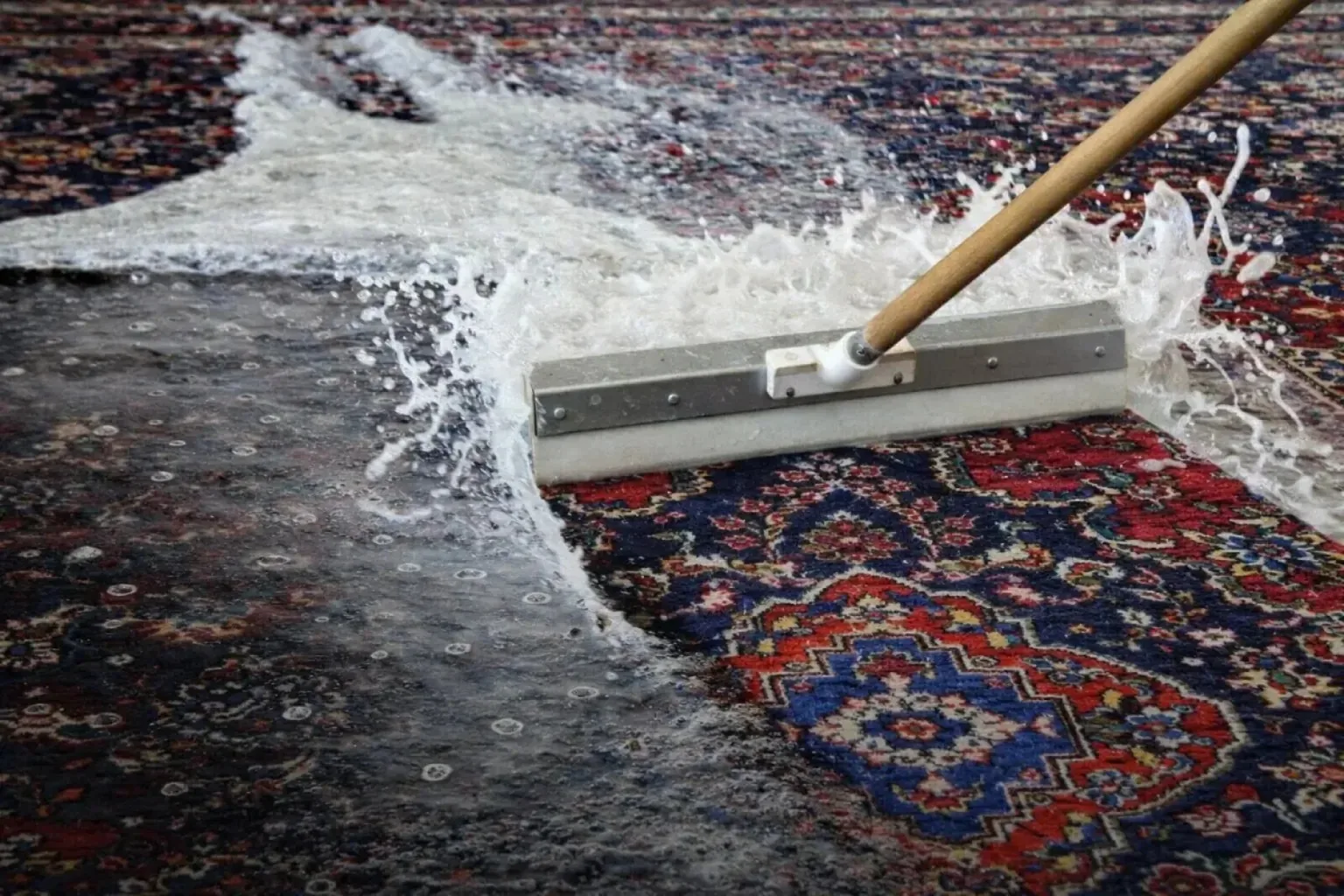
Removing Excess Water with a Rug Squeegee After Washing
Once a Persian handmade rug has been completely rinsed, a substantial amount of free water should be removed before the rug is transferred to its drying area.
In traditional washing practice, this may be done with a purpose-made rug squeegee or paddle-like tool with a suitable smooth edge.
The movement should be calm, even, and controlled and, as far as the rug allows, should follow the natural direction of the pile.
The purpose is not to force every drop of water out with maximum pressure.
The purpose is to reduce free surface water and prepare the rug for safe, efficient drying.
Avoid dragging a hard or unsuitable edge roughly in different directions, applying excessive pressure, twisting the rug, or wringing it.
This caution becomes even more important with delicate, old, damaged, or silk Persian rugs.
After initial dewatering, the wet rug should be moved carefully to the drying area.
The logical sequence is:
Washing → thorough rinsing → controlled water extraction → careful transfer → effective air circulation → complete drying
This often-overlooked water-extraction stage is important because it shortens the period during which the rug remains heavily saturated without requiring the destructive forces associated with twisting or wringing.
Drying Is as Important as Washing
Even a correctly washed rug can develop problems if it is dried badly.
A rug should not remain wet for a long period in stagnant air.
Natural fibers such as wool and silk can absorb moisture, and prolonged dampness combined with inadequate ventilation creates unfavorable conditions for a handwoven textile.
The objective is not merely to make the top of the pile feel dry.
Moisture must also leave the deeper structure and the back of the rug.
Why Airflow Under the Rug Matters
Where conditions permit, one practical approach is to place the rug on a completely clean raised platform, clean pallet, or another suitable support that permits airflow.
The benefit is not simply that the rug is separated from the ground.
A gap beneath the rug allows air to circulate under the foundation as well as above the pile, helping moisture escape from both sides.
There is an important condition:
The support beneath the rug must be completely clean and safe.
It must be free of oil, rust, dirt, nails, sharp wood splinters, rough edges, or anything else capable of staining, snagging, or physically damaging the rug.
The wet rug is heavier and more vulnerable to distortion, so the support should also distribute its weight appropriately.
Should a Persian Handmade Rug Be Dried in Sunlight?
Fresh air and suitable natural conditions can assist drying, but there is an important difference between controlled natural light and prolonged exposure to intense direct sunlight.
A valuable Persian handmade rug should not simply be abandoned for hours in severe sun without supervision.
Repeated or prolonged intense light exposure can contribute to fading and changes in the appearance of textile fibers and dyes.
The goal is therefore not to find the strongest possible sun.
The goal is to create good drying conditions:
fresh air + airflow above and below the rug + controlled natural light + enough time for complete drying.
Environmental conditions matter. Temperature, humidity, airflow, rug thickness, foundation material, and the amount of water remaining after rinsing all affect drying time. There is no responsible universal number of hours that applies to every rug.
Never Roll or Store a Rug Before It Is Completely Dry
The surface may feel dry while moisture remains in the foundation or on the reverse.
Before rolling, folding, reinstalling, or storing the rug, check that drying is complete throughout the structure.
Inspect the back as well as the pile.
Do not rush this stage.
A rug stored while still damp may develop odor, dimensional problems, or other moisture-related deterioration.
A Persian Wool Rug Is a Luxury Floor Covering That Can Be Used
Much of the practical advice about everyday stains and routine cleaning applies most directly to Persian wool rugs.
A high-quality wool rug can be both luxurious and functional.
It may be used in a reception room, living room, bedroom, office, or guest space. People walk on it, and furniture may rest partly on it.
A wool rug used on the floor is therefore more likely to encounter household dust, drinks, and ordinary contamination than a textile displayed on a wall.
This is not a weakness of wool rugs.
Persian wool carpets have been part of lived interiors for centuries.
The objective is not to avoid using the rug.
The objective is to use it intelligently and maintain it correctly.
Fine Qom Silk Rugs Require a Different Approach
The situation changes when we discuss a very fine handmade Qom silk rug.
Many exceptionally fine Qom silk rugs should not be regarded simply as ordinary floor coverings.
Very fine knots, silk luster, high knot density, complex design, intricate detail, and an extraordinary investment of skilled labor can place such a rug closer to a handwoven textile artwork or collectible object.
For this reason, some owners and collectors display fine Qom silk rugs on a wall or in a protected interior rather than subjecting them to routine floor traffic.
Under those conditions, the risk of tea, coffee, food, footwear soil, and other everyday contaminants is naturally reduced.
Many of the practical household-cleaning recommendations in this article therefore apply primarily to Persian wool rugs used as luxury floor coverings.
Can a Qom Silk Rug Be Washed at Home?
For a high-value Qom silk rug, our recommendation is considerably more conservative.
A simple method that may be appropriate for a sound, colorfast wool rug should not automatically be transferred to silk.
Wool and silk do not behave identically.
The visual character of a silk rug also depends strongly on pile direction, surface condition, light reflection, and the integrity of its fine construction. Incorrect washing, brushing, chemical treatment, or drying can alter that appearance.
If a valuable Qom silk rug genuinely requires full washing, it is safer to entrust it to a specialist with demonstrable experience in washing and conserving handmade silk rugs.
A valuable textile artwork is not an appropriate place to experiment with an untested household cleaning method.
Special Considerations for Old and Antique Persian Rugs
Age does not automatically mean weakness.
Some historic rugs retain excellent structural integrity.
Nevertheless, before an old rug is washed, the condition of the pile, warp and weft, fringes, side finishes, previous repairs, weakened areas, and foundation should be assessed.
An area that appears stable when dry may behave differently once saturated and made heavier by water.
For that reason, home washing of a valuable antique Persian rug without specialist assessment is not recommended.
With an antique rug, the objective is not merely to make it look cleaner.
Preserving original structure, historical character, and artistic value is equally important.
Cleaning decisions should therefore be proportional to the rug's condition and significance.
Vacuuming a Persian Handmade Rug
Regular cleaning can extend the interval between full washes.
When loose dust is removed routinely, it has less opportunity to work deep into the pile.
Vacuum power, floor-head design, and technique should be appropriate for the age, material, pile, and condition of the rug.
A powerful rotating brush should not repeatedly catch or pull the fringes.
The fringes of a Persian handmade rug are not simply decorative strings; they are related to the rug's structural warp system.
Very fine, antique, weakened, or silk rugs require still more caution.
The goal of routine vacuuming is controlled dust removal, not aggressive mechanical grooming.
Respond Quickly to a Stain, but Do Not Make Hasty Decisions
This may sound contradictory:
Act quickly, but do not act recklessly.
If tea is spilled, absorb the liquid promptly.
But do not immediately reach for the strongest chemical in the house.
If an unknown material lands on the rug, remove the excess carefully.
But do not test several unrelated chemicals one after another.
Rapid control of contamination is sensible.
Random chemical experimentation is not.
Common Mistakes When Washing Persian Handmade Rugs
Using chlorine bleach to remove a stain is a serious mistake.
Aggressive scrubbing with a hard brush can damage or distort the pile. Excess detergent, incomplete rinsing, prolonged wetness, rough handling of a saturated rug, rolling before complete drying, and long exposure to intense direct sunlight are also practices to avoid.
Another major mistake is assuming that every Persian handmade rug can be cleaned with the same method.
That is not true.
A robust wool rug, a fine silk rug, an antique carpet, and a structurally damaged rug may require entirely different levels of intervention.
Material, dye stability, construction, age, previous repairs, condition, and value should all influence the cleaning decision.
How to Choose a Specialist Persian Rug Cleaner
If you decide to use a professional, do not rely only on a general claim that a company “cleans carpets.”
Ask whether they have genuine experience with Persian handmade rugs.
If the rug is silk, ask specifically about their experience with handmade silk rugs.
If the piece is a fine, high-value Qom silk rug, experience with valuable silk textiles becomes especially important.
Useful questions include:
Do you test or assess colorfastness before washing?
How is the rug washed?
How is it rinsed?
How is excess water removed?
How and where will it be dried?
How are fragile fringes, side finishes, repaired areas, and weakened sections handled?
Before handing over a valuable rug, photograph the front, back, fringes, side finishes, existing stains, wear, and previous repairs.
These photographs create a practical record of the rug's condition before cleaning.
For especially valuable pieces, written documentation of condition and agreed treatment is also sensible.
How Can a Persian Handmade Rug Be Preserved for the Next Generation?
There is no single secret.
Long life comes from a group of simple, correct habits.
Prevent unnecessary contamination.
Remove dust regularly and gently.
Manage spills promptly.
Keep strong chemicals away from the rug.
Do not leave the rug damp for prolonged periods.
Wash it only when its actual condition justifies washing.
Use appropriate support and airflow during drying.
And, most importantly:
Know what you own.
A Persian handmade rug is not a disposable, short-term household item.
It is a handwoven textile object whose material, technique, regional tradition, and human workmanship deserve informed care.
Can a Persian Handmade Rug Really Last for Centuries?
No responsible seller should guarantee that every Persian handmade rug will survive for several hundred years regardless of use, environment, accidents, or maintenance.
However, a high-quality Persian handmade rug made from sound materials and construction, kept in a suitable environment, and maintained correctly has the potential for an exceptionally long life.
Surviving historic Persian carpets demonstrate that such longevity is possible.
A good rug does not necessarily belong only to one room or one owner.
With proper care, it can pass from one generation to the next.
Frequently Asked Questions About Washing Persian Handmade Rugs
How often should a Persian handmade rug be washed?
There is no single fixed interval. Traffic, environment, dust, stains, maintenance history, fiber type, and the rug's actual condition should determine whether full washing is necessary.
Does a Persian handmade rug need to be washed every year?
No. If the rug remains clean and has been maintained correctly, the fact that one year has passed is not by itself a reason for full wet washing.
What should I do if tea or coffee spills on a Persian wool rug?
Blot the liquid promptly with a clean white absorbent cloth without aggressive rubbing. On a sound, colorfast wool rug, cautious mild spot cleaning may be sufficient. If rug dye transfers to the cloth, stop.
Can a Persian handmade rug be washed with water and soap?
Some sound, colorfast Persian wool rugs may be suitable for simple washing with water and a limited amount of mild soap. This advice does not automatically apply to silk, antique, damaged, repaired, or color-unstable rugs.
When is the rug squeegee or paddle used?
After washing and thorough rinsing, and before transferring the rug to the drying area. Its purpose is to remove excess free water with controlled movements, preferably following the pile direction, rather than to apply harsh pressure.
Why is water extraction important before drying?
A saturated rug is extremely heavy and can remain wet for too long. Controlled removal of free water reduces the moisture load before drying and can support safer handling and more efficient evaporation without twisting or wringing the textile.
What is the best way to dry a Persian handmade rug?
Complete drying and effective air circulation are the priorities. Under suitable conditions, a clean raised support that allows air to pass beneath the rug as well as above it can be useful.
Can a Persian rug be dried in direct sunlight?
Fresh air and controlled natural light can assist drying, but prolonged exposure of a valuable rug to intense direct sunlight is not recommended. Airflow and complete drying matter more than maximum sun exposure.
Can a Qom silk rug be washed like a wool rug?
It is not recommended. Silk requires more careful assessment and handling. For a valuable Qom silk rug, a specialist with genuine experience in handmade silk rugs is the safer choice.
Which cleaning products should not be used on a Persian handmade rug?
Chlorine bleach, strong acids or alkalis, aggressive solvents, and unknown chemicals should not be experimented with on a valuable handmade rug.
Conclusion
If this entire guide were reduced to one sentence, it would be:
Care for a Persian handmade rug well enough that full washing is needed as rarely as reasonably possible.
A high-quality Persian handmade rug is not an ordinary, short-lived floor covering.
A Persian wool rug can remain a luxurious yet practical part of an interior for many years.
A very fine Qom silk rug, on the other hand, may reasonably be treated as a collectible textile artwork.
The owner of a Persian handmade rug should recognize the materials, time, skill, and human labor embodied in it.
Once a rug reaches its owner's home, its future also depends greatly on how it is used and maintained.
Prevent unnecessary contamination.
Remove dust regularly and gently.
Respond to stains quickly but intelligently.
Keep bleach and aggressive chemicals away.
Do not wash the rug more often than necessary.
For a suitable Persian wool rug, prefer a mild method to a harsh chemical treatment.
After thorough rinsing, remove excess water in a controlled manner.
Then give air circulation and complete drying the same importance as the washing itself.
And if you own a Qom silk rug, an antique Persian carpet, or another exceptionally valuable textile, do not risk its future with uncertain household experiments.
If a Persian handmade rug is cared for with some of the same patience and respect invested in weaving it, it can remain with a family for a very long time and may ultimately pass from one generation to another.
Less unnecessary washing, better preventive care, and informed preservation of Persian handmade rugs for the future.
Sources and Basis of This Article
This article is based on Hamed Khodabakhshi's knowledge and practical experience with Persian handmade rugs, together with study of specialist Iranian sources related to handwoven carpets.
Iran Carpet Company
https://irancarpet.ir
Iranian Carpet Scientific Association
https://www.icsa.ir
Author's knowledge and experience: Hamed Khodabakhshi