Tabriz hand knotted rugs occupy a distinctive place within the broad and diverse tradition of Persian carpet weaving. They cannot be defined by a single design, one material, one colour palette or one level of knot density. Their identity has developed through the interaction of artistic knowledge, technical discipline, workshop organisation, regional culture and the historic position of Tabriz as one of Iran’s most important commercial gateways.
I am Hamed Khodabakhshi, an Iranian hand knotted carpet exporter and CEO of Persian Royal Rug. In my professional experience, I have examined Tabriz carpets that differ so greatly from one another that an unfamiliar buyer might not immediately recognise them as products of the same weaving centre. Some are durable wool carpets intended for long term residential use. Others are fine wool and silk rugs, silk foundation carpets, signed workshop pieces or highly detailed pictorial works created with a degree of precision closer to Persian miniature painting than ordinary floor covering.
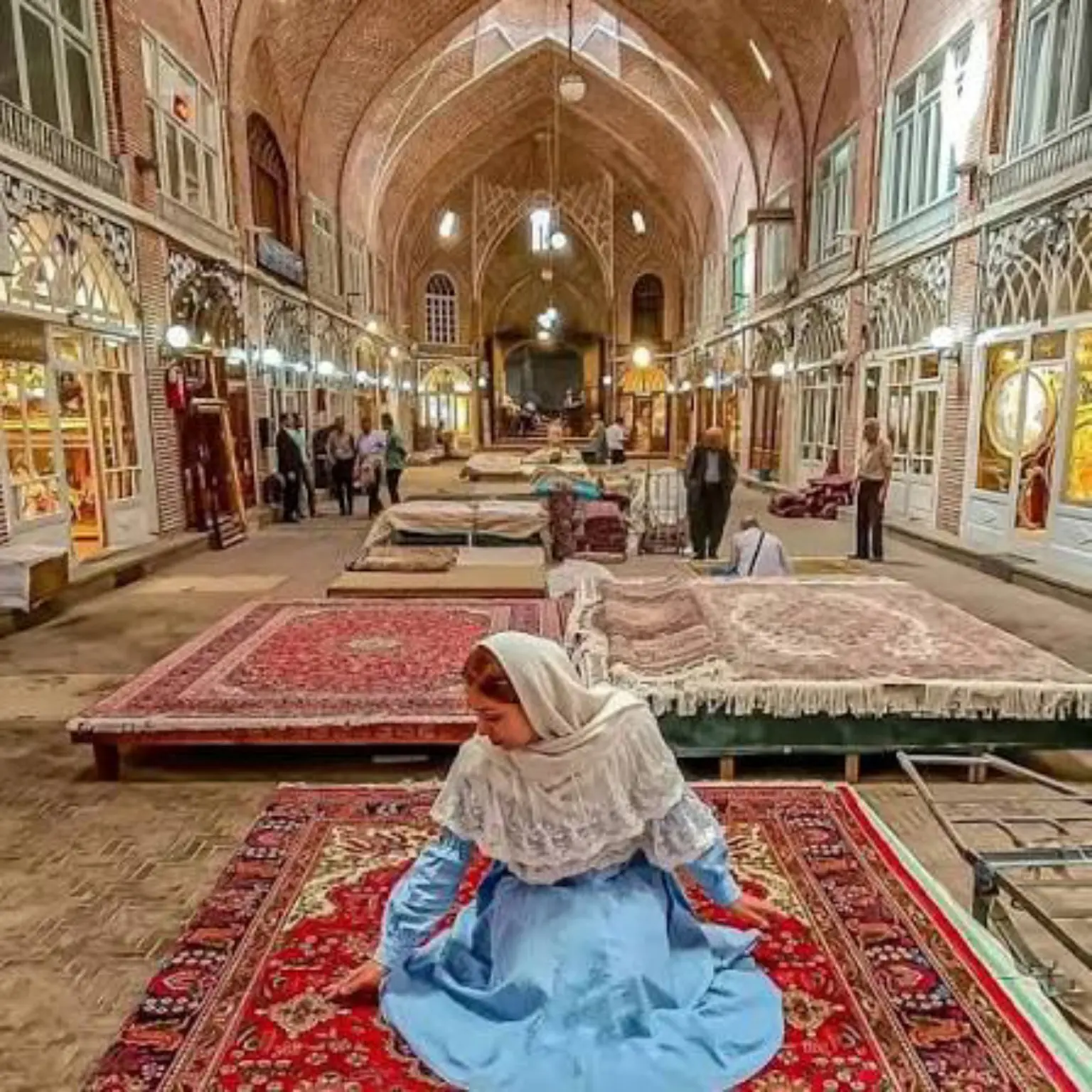
This range is part of the strength of Tabriz. The city has produced formal medallion carpets, all over Mahi designs, Tree of Life compositions, garden carpets, pictorial rugs, floral works and large architectural commissions. It has also supported several levels of production, from practical household carpets to rare works sought by collectors.
Terms such as Tabriz rug, Persian Tabriz carpet, Tabriz Mahi rug, Tabriz wool and silk rug, signed Tabriz rug, 50 Raj Tabriz rug and 70 Raj Tabriz carpet are widely used in international trade. None of these descriptions is enough on its own to establish quality or value. A serious assessment must consider the foundation, pile, knot structure, weft arrangement, materials, drawing, colour, finishing, condition, repairs, signature, provenance and workshop attribution together.
This article presents Tabriz carpet weaving as a living artistic and commercial tradition. It is intended for collectors, interior professionals, informed buyers, dealers and readers who wish to understand what separates a strong Tabriz rug from an ordinary example. It also explains what buyers should expect when viewing Tabriz hand knotted rugs for sale or working with an exporter of Tabriz carpets.
Tabriz as a City of Art and Commerce
Tabriz has long been one of the major cultural and commercial cities of Iran. Its position in the northwest of the country connected it with routes leading towards Anatolia, the Caucasus, Central Asia and Europe. Goods, raw materials, designs, artistic ideas and commercial preferences moved through these routes.
The historic bazaar of Tabriz was more than a place of retail exchange. Its caravanserais, workshops, storage spaces and trading chambers brought merchants, designers, dyers, weavers, finishers and exporters into a connected economic environment. A carpet might begin with a commission from a merchant, pass through the hands of a designer and colour planner, be woven in a workshop or domestic setting, then return to the commercial network for sale or export.
This relationship between artistic production and international trade shaped the character of Tabriz weaving. Designers and workshop owners were familiar with both Iranian taste and foreign demand. They could adjust scale, dimensions, colour balance and composition while preserving the visual language of Persian art.
This adaptability did not make Tabriz carpets culturally anonymous. On the contrary, it allowed them to carry Persian motifs into different architectural settings. A large medallion carpet could be designed for a European reception room, while a fine Mahi rug might suit a more intimate interior. A pictorial carpet could be collected as woven art, while a strong wool carpet could remain in daily use for generations.
The commercial intelligence of Tabriz should not be separated from its artistic achievement. Trade created access to capital, commissions and distant markets. Art gave the product its cultural value. The most successful periods of Tabriz carpet production brought these two forces together.
Early Artistic Foundations
Any discussion of the early history of Tabriz carpet weaving requires caution. The ancient history of a city or the presence of textile production in a region does not by itself prove that knotted pile carpets identical to later Tabriz examples were made there at a specific date.
Historical attribution must be based on surviving objects, documentary evidence, technical analysis, inscriptions and careful comparison. Many early Persian carpets do not carry a workshop name or a reliable statement of origin. Museum catalogues may therefore use cautious expressions such as “probably Tabriz” or “northwest Persia”.
This uncertainty does not reduce the importance of Tabriz. It shows that carpet history should be studied with the same discipline used in other fields of art history. A confident commercial label is not always the same as a documented scholarly attribution.
During the Ilkhanid and Timurid periods, Tabriz became an important centre for manuscript production, painting, illumination and decorative design. The artistic vocabulary developed in these fields later became closely connected with carpet design. Central medallions, scrolling arabesques, floral systems, cloud bands, animals and carefully organised borders all belonged to a wider culture of Persian design.
Carpet designers did not work in complete isolation from painters, illuminators, calligraphers or architects. The relationship between these arts helped create compositions that could be transferred from paper to a woven grid without losing their rhythm and symbolic power.
Tabriz and the Safavid Artistic World
Tabriz held major political and artistic importance during the early Safavid period. Court workshops brought together artists working in painting, manuscript illumination, textiles and other decorative arts. This environment contributed to the development of sophisticated carpet compositions.
The transformation of a drawing into a carpet design requires a special kind of intelligence. Curved lines must be translated into a grid. Figures must remain expressive despite being built from knots. Flowers must retain movement, and the balance between the field and borders must survive enlargement to architectural scale.
The visual relationship between Safavid carpets, manuscript illumination and book covers is therefore not accidental. These works share principles of symmetry, proportion, layered borders, floral movement and controlled ornament.
At the same time, it is important not to describe every major Safavid carpet as a Tabriz product. Some works have been associated with Tabriz through design, court patronage or historical context, but their exact weaving location remains debated. A responsible article should distinguish between a connection to the Tabriz artistic environment and a proven workshop origin.
This distinction is particularly important in the international market, where prestigious city names may be applied too freely. Historical pride becomes stronger, not weaker, when it is supported by accurate language.
Decline, Continuity and Renewal
Political change, war, the movement of royal capitals and shifts in patronage affected artistic production in Tabriz. Large court workshops could decline or move, while commercial networks changed direction. Yet the knowledge of weaving did not disappear.
Skills survived through families, neighbourhood workshops and regional networks. Designers continued to draw, dyers continued to prepare yarn and weavers continued to pass practical knowledge from one generation to the next.
The great commercial renewal of Persian carpet production during the nineteenth century gave Tabriz a new position. European and American demand for Persian carpets increased, and merchants in Tabriz were well placed to organise production for export.
Workshops became more structured. Large carpets were commissioned for foreign interiors. Designs were adjusted to suit new dimensions, while the underlying language remained Persian. Colour palettes could be modified in response to international taste, but the best works did not become mere imitations of European decoration.
This period produced many carpets that are now regarded as important antiques. Their appeal lies not only in age, but in the quality of drawing, materials, colour and construction. The late nineteenth and early twentieth centuries also established workshop names that continue to influence the collector market.
How Can a Tabriz Rug Be Identified?
There is no single feature that identifies every authentic Tabriz rug. The city has produced too wide a range of carpets for one simple rule to work.
Many Tabriz carpets display disciplined urban drawing, carefully structured borders and a strong ability to render curved floral forms. The symmetrical knot is common. Cotton foundations are widely found, while silk foundations appear in finer examples. Wool, fine wool, silk highlights and full silk construction may all occur.
Some Tabriz carpets have a large central medallion. Others use an all over field without a dominant centre. Colours may be deep and formal or pale and restrained. Pile height can vary according to period, material and intended use.
Origin should therefore be assessed through a combination of evidence. The back of the carpet reveals knot structure, weft arrangement, foundation materials and repairs. The front shows drawing, colour, pile and finishing. Size, handle, edge construction and comparison with documented examples add further information.
A seller who identifies a carpet as Tabriz only because it contains a medallion or a Mahi pattern is not providing enough evidence. Both motifs occur in other Persian weaving regions.
The Symmetrical Knot in Tabriz Weaving
Many Tabriz carpets are woven with the symmetrical knot, also known in the trade as the Turkish knot or Ghiordes knot. In this construction, the pile yarn wraps around two adjacent warps and emerges between them.
When executed with skill, the symmetrical knot can create a firm and regular structure. It suits disciplined workshop production and can support highly detailed drawing when fine yarn and close warps are used.
The knot type alone does not determine quality. A carpet may use the traditional knot but still suffer from uneven tension, weak materials, poor clipping or inconsistent weaving. Another rug with a more moderate knot density may be technically and artistically superior because its structure is balanced.
Foundation tension is particularly important. If the warps are stretched unevenly, the carpet may narrow, widen or develop waves. Irregular weft insertion can alter the spacing between rows. Excessive beating may make the carpet too stiff, while insufficient beating can create instability.
Pile clipping also affects the final appearance. If the pile remains too high, fine details become blurred. If it is clipped too low, knots may become exposed and the carpet can be vulnerable to wear. Good finishing reveals the design while preserving enough pile for strength and visual depth.
Warp, Weft and Foundation
A hand knotted carpet is built from warp, weft and pile. The warps run vertically and form the structural skeleton. The pile knots are tied around the warps. After each row, or according to the structure of the carpet, weft yarns pass across the width and are beaten into place.
Cotton is widely used for the foundation of Tabriz carpets because it provides strength, relative stability and a suitable base for precise urban designs. A well prepared cotton foundation supports straight edges and regular dimensions.
Silk foundations are found in finer carpets. Silk allows the use of thinner warps and can support higher knot density, but the phrase “silk foundation” should never be treated as an automatic guarantee of excellence. The quality of the silk, the accuracy of warping, the weft structure and the balance between foundation and pile remain essential.
The back of a carpet often reveals information that cannot be seen clearly from the front. Irregular rows, offset warps, repairs, colour changes and structural weakness may all become more visible. For this reason, serious buyers should always request clear photographs of the reverse.
At Persian Royal Rug, we believe that the material description should identify the warp, weft and pile separately whenever possible. A vague description such as “silk rug” may conceal a carpet with only limited silk highlights.
Understanding Raj Count
Raj count is one of the best known technical terms associated with Tabriz carpets. In the traditional Tabriz system, knots are counted across a unit measuring approximately seven centimetres.
A 50 Raj Tabriz rug offers enough density for detailed floral drawing when the yarn and workmanship are good. A 60 Raj carpet allows finer curves and smaller decorative elements. A 70 Raj Tabriz rug belongs to a very fine category and requires thin yarn, accurate foundations and considerable weaving skill.
The number increases in importance because knot density rises in both directions. A higher Raj count can therefore represent a substantial increase in the number of knots per square metre.
Yet Raj count is still only one measurement. It does not evaluate the quality of wool, the strength of the design, the harmony of colour or the condition of the carpet. A well designed 50 Raj rug can be more desirable than a 70 Raj carpet with weak drawing and lifeless colour.
In my own professional assessment of Persian carpets, I treat Raj count as evidence, not a final judgement. It tells us what level of detail the structure can support. It does not tell us whether the artist and weaver used that possibility well.
The most meaningful question is not simply “How many Raj?” It is “What has been achieved with this Raj count?”
Wool in Tabriz Carpets
Wool remains one of the most important materials in Tabriz carpet weaving. Good carpet wool needs strength, flexibility, colour absorption and an appropriate level of softness.
Softness alone is not a reliable measure of quality. Very soft wool may not always be suitable for heavy domestic use. A slightly firmer wool with good resilience may provide better durability while still producing an attractive surface.
The quality of wool is influenced by breed, climate, the part of the fleece, shearing season, washing, spinning and yarn twist. Two yarns both described as wool can behave very differently.
Handspun wool may show gentle variation in thickness. When controlled, this variation gives the surface life and character. Severe inconsistency, weak fibres or poor preparation can cause premature wear.
A strong wool Tabriz carpet can be a practical choice for a living room, library or reception area. It may not have the intense shine of silk, but it can offer warmth, depth of colour and long service when properly maintained.
Pile height must suit the material and design. A short pile can reveal fine drawing, but it should not be clipped so deeply that the foundation becomes vulnerable. The best balance depends on the yarn, knot density and intended function.
Fine Wool, Kork and Silk
The term kork is commonly used in the carpet trade for fine, soft wool. Tabriz rugs described as kork and silk often use fine wool for most of the pile and silk to highlight selected parts of the design.
Silk may define flower outlines, medallion details, leaves, inscriptions or border elements. Its different reflection of light creates visual depth, even when the pile surface is physically level.
Good use of silk should support the design. It should guide the eye towards important details. When silk is added without artistic purpose merely to make a carpet appear luxurious, the result can become visually restless.
Buyers should ask where the silk is used and whether the foundation is cotton or silk. The term “wool and silk” does not explain the proportion, location or quality of either material.
Lighting can also mislead. Strong showroom lights and edited photographs can exaggerate shine. A video showing the carpet from both directions of the pile provides a more realistic understanding of the materials and colour.
A successful Tabriz wool and silk rug combines the resilience and warmth of wool with the precision and changing light of silk. Neither material should dominate at the expense of the design.
Silk Foundation and Full Silk Tabriz Rugs
A silk foundation allows narrow spacing between warps and can support very fine weaving. This is one reason some high Raj Tabriz carpets use silk warps.
However, silk foundation does not necessarily mean full silk. The pile may be wool, fine wool, silk or a combination. The weft may also differ from the warp.
The expression “full silk Tabriz carpet” should be used only when the principal structural components are genuinely silk. Artificial fibres or other glossy materials should not be described as natural silk.
Fine silk carpets can render faces, petals, calligraphy and architectural details with remarkable precision. Their surface changes with the direction of light, giving the design a living quality.
They also require careful use. A fine silk rug is not the ideal choice for a heavily trafficked entrance or dining area. Direct sunlight, moisture, unsuitable cleaning and concentrated furniture pressure can damage it.
For collectors, the value of a silk Tabriz carpet depends on more than brilliance. Silk quality, drawing, knotting, colour balance, condition and workshop identity all matter.
Dyeing and Colour
Colour is not an added decoration in a Tabriz carpet. It is part of the architecture of the design. The field, medallion, corners, borders and small motifs depend on a controlled relationship between colours.
Traditional dyes could be produced from madder, walnut husk, pomegranate skin, indigo and other natural materials. The final colour depended not only on the plant or dye source, but also on water quality, mordants, temperature, timing, yarn preparation and the experience of the dyer.
Synthetic dyes entered Persian carpet production during the nineteenth century. It is therefore inaccurate to assume that every antique Persian rug uses only natural dyes. Some early synthetic dyes were unstable, while later synthetic colours can be technically reliable.
The important question is how the colours behave together and how they have aged. A natural dye is not automatically beautiful, and a synthetic dye is not automatically poor. Harmony, depth, stability and suitability for the design must be considered.
Tabriz carpets may use deep reds and indigo blues, ivory fields, muted earth tones, soft rose, copper, gold, green and pale blue. The palette of a nineteenth century collector carpet may differ significantly from that of a modern workshop piece.
Abrash and Natural Colour Variation
Abrash describes a gradual variation in colour within a woven area. It may occur when yarn from one dye batch is replaced with yarn from another, or when hand prepared fibres absorb colour differently.
A gentle and coherent abrash can add life to a carpet. It records the rhythm of material preparation and hand production. In an old rug, it may be considered part of the object’s character.
Not every colour difference is abrash. Sun fading, stains, chemical cleaning, local washing and repairs may create changes that look similar in a photograph.
The direction and boundary of the variation should be examined. Abrash often follows rows of weaving. Fading may correspond to exposure. A repair may show changes in knot structure, yarn texture and pile height as well as colour.
When a Tabriz rug is offered for international sale, such features should be described accurately. Transparency helps a remote buyer distinguish natural variation from damage or restoration.
The Mahi or Herati Design
The Tabriz Mahi rug is one of the most recognisable categories in the market. Mahi means fish, while Herati refers to the broader design family.
The pattern usually contains a central floral element surrounded by curved leaves that may resemble fish. This unit repeats across the field, creating a continuous visual rhythm.
The strength of a good Mahi design lies in consistency. Each unit must relate to the next without becoming mechanical. The spaces between motifs should be controlled, and the border must support the movement of the field.
Higher knot density allows smaller Mahi units and more refined drawing, but density alone does not guarantee a successful result. If the repeat is poorly spaced or colour contrast is weak, the carpet may appear confused.
It is also important to recognise that Herati designs are woven in several Persian regions. A Mahi pattern by itself does not prove Tabriz origin. Structure, materials, colour, handle and documented provenance must be considered.
Medallion and Corner Designs
The central medallion is one of the most familiar features of formal Tabriz carpets. The medallion acts as the visual centre, while corner pieces complete the composition.
Proportion is critical. An oversized medallion can compress the field. A small medallion may lose authority. The width and complexity of the borders must also correspond to the scale of the centre.
Pendant forms may extend above and below the medallion, reinforcing the vertical axis. Floral sprays, arabesques and Shah Abbasi flowers often move through the surrounding field.
A strong medallion carpet must work at two distances. From across a room, it should present a balanced whole. At close range, it should reveal refined details.
In interior placement, the medallion should not be hidden carelessly beneath furniture. Buyers should consider room dimensions and furniture arrangement before selecting a formal central design.
All Over Floral Designs
An all over design distributes floral elements across the field without relying on a dominant central medallion. Afshan and repeating floral patterns belong to this broad category.
These designs can suit contemporary interiors because furniture placement does not interrupt a central motif. They also create a sense of movement across the entire surface.
An all over field is not easier to design. The artist must control spacing, direction and colour so the eye can move without encountering empty gaps or congested areas.
Curved branches should connect naturally. Corners must resolve properly. The border should frame the movement rather than compete with it.
A finely drawn all over Tabriz carpet can appear calm despite containing hundreds of individual motifs. This quality depends on visual hierarchy, not simplicity.
Shah Abbasi Flowers, Arabesques and Khatai Vines
Shah Abbasi flowers are among the most important motifs in classical Persian carpet design. In Tabriz carpets they often appear with arabesques, palmettes and Khatai vines.
Arabesques must carry movement. Their curves should feel continuous rather than stiff. Khatai vines should connect floral elements and guide the eye instead of merely filling empty space.
The quality of drawing can often be judged where lines turn sharply or pass around a flower. Weak designs show awkward connections, broken curves or compressed motifs.
A fine Tabriz rug may contain a large number of small elements, but the overall movement remains readable. Detail serves structure.
This is another reason knot count should not be judged separately from design. High density creates the possibility of precision. The designer and weaver must convert that possibility into coherent art.
Tree of Life Designs
The tree is one of the enduring symbols of Persian art. It may represent growth, continuity, fertility, knowledge or the connection between earthly and spiritual life.
Tabriz Tree of Life rugs may contain cypress trees, flowering branches, birds, animals, vases and architectural or prayer forms. The composition often develops vertically from the lower part of the field.
The designer must combine the natural movement of branches with the geometric order of a carpet. A successful tree appears alive but remains balanced.
Tree designs can be highly attractive to collectors when the drawing is distinctive, the colours are well aged or the work is connected to a recognised workshop.
Rismanbor carpets include examples associated with Tree of Life, vase and floral compositions. As with every workshop attribution, the quality of each individual piece should be assessed independently.
Vase Designs
In a vase carpet, flowers and branches rise from one or more containers. The vase may form the central lower element or repeat throughout the field.
Balance is difficult to achieve. If the vase is too small and the floral crown too large, the design appears unstable. If the vase is too dominant, the branches lose movement.
Birds may be placed among the flowers, adding narrative and rhythm. Fine weaving allows subtle changes in petal colour and outline.
A good vase design demonstrates both artistic drawing and technical control. The value does not come from the number of flowers, but from the relationship between the vessel, branches, field and borders.
Garden Designs
Garden carpets divide the field into compartments that may contain trees, flowers, water channels, birds and animals. Their organisation reflects the geometry and symbolism of the Persian garden.
The challenge is to maintain unity across many separate panels. Each compartment can contain a different scene, but the carpet must still read as one complete composition.
Some documented Haji Jalili Tabriz carpets use garden layouts. Their presence in international auction records confirms the importance of this design within the finest historical production of Tabriz.
A garden carpet should be examined both as a decorative object and as a structured representation of nature. Its beauty depends on the conversation between geometry and organic form.
Hunting and Pictorial Carpets
Hunting designs bring riders, animals, trees and movement into a complex narrative field. Pictorial carpets may show poets, rulers, historical figures, architecture, landscapes or literary scenes.
Translating a face or moving figure into knots is demanding. Shading, expression and proportion must be reduced to a limited grid and controlled palette.
High Raj count can help render detail, but it cannot correct weak drawing. A technically dense portrait may still lack expression.
The artistic value of a pictorial rug should not be measured only by resemblance to a photograph. Composition, subject, colour, originality and the transformation of an image into textile language are equally important.
The finest examples function as woven pictures. They may be displayed on walls or preserved in collections rather than placed in areas of regular foot traffic.
Famous Tabriz Carpet Designers
The history of Tabriz carpets is incomplete without its designers. A designer must understand painting, ornament, proportion and the practical realities of weaving.
Names associated with the Tabriz design tradition include Mir Mosavver, Hossein Taherzadeh Behzad, Mohammad Ali Gharabaghi, Pourkazem, Shokour Taghizadeh and Hossein Pourkazem.
Mir Mosavver belongs to the wider artistic world of Tabriz painting and design. His legacy reflects the environment in which miniature painting, decorative drawing and carpet composition influenced one another.
Hossein Taherzadeh Behzad was born in Tabriz and became an important figure in carpet design and illumination. The Iran Carpet Scientific Association notes the range of his designs and their continuing educational use.
Mohammad Ali Gharabaghi is recognised within the Tabriz carpet design community. An interview published by the Iran Carpet Scientific Association offers valuable insight into his creative practice and direct understanding of carpet drawing.
These names should be introduced with care. A design associated with a master is not always drawn personally by that individual, and a workshop may continue using a design after the original artist’s lifetime.
Pourkazem and the Importance of Teaching
The Iran Carpet Scientific Association records that Master Pourkazem established his first organised carpet workshop in the Rasteh Kucheh district of Tabriz in 1945 and later expanded his activities in the Gharah Aghaj area.
The importance of this workshop was not limited to production. It also became a place where artistic knowledge was transmitted.
Mohammad Ali Gharabaghi, Hossein Pourkazem and Shokour Taghizadeh are among the figures connected with this line of teaching.
A master who trains capable artists leaves a legacy beyond the carpets carrying his own name. The workshop becomes a school of drawing, judgement and technical discipline.
This collective dimension is essential to understanding Persian carpets. A great work may carry one signature, but its creation often depends on many people.
Designer, Cartoon Maker, Weaver and Workshop Owner
Commercial descriptions often collapse several roles into one name. In reality, the designer, cartoon maker, dyer, weaver, workshop owner and merchant may be different individuals.
The designer creates the composition. The cartoon maker translates it into a knot by knot plan. The colourist assigns yarn colours. The dyer prepares them. The weaver executes the design row by row. The workshop owner may finance production, manage quality and organise sale.
A signature woven into the carpet may identify the designer, workshop, producer or commercial house. It does not necessarily mean that the named person tied the knots.
Recognising these distinctions gives proper credit to the people involved and prevents misleading attribution.
Haji Jalili Tabriz Carpets
Haji Jalili is one of the most recognised historical names associated with Tabriz carpet weaving. Carpets attributed to his workshop, particularly from the late nineteenth century, appear in international auction records and important private collections.
Many are admired for refined drawing, disciplined proportions and restrained colour palettes. Soft rose, copper, ivory, muted blue and earth tones are frequently associated with the group, although not every Haji Jalili carpet follows one fixed palette.
Medallion, floral and garden designs can all be found. Some works are large and architectural, while others are more intimate.
The prestige of the name has also created a risk of over attribution. A pale antique Tabriz carpet is not automatically a Haji Jalili piece. The structure, age, drawing, materials, provenance and comparison with documented examples must support the description.
When certainty is limited, “attributed to the Haji Jalili workshop” is more responsible than an absolute claim.
The Rismanbor Workshop
Rismanbor is a contemporary name associated with Tabriz hand knotted carpet production. Examples connected with the workshop include Tree of Life, vase, floral and finely organised urban compositions.
I have encountered Rismanbor carpets during my professional work with Persian rugs. In my view, their assessment should follow the same independent standards applied to any recognised workshop.
The workshop name is relevant, but it does not replace examination. Raj count, foundation material, pile composition, quality of silk, drawing, colour, clipping, edge construction, condition and signature must all be reviewed.
Two carpets from the same workshop can differ because they were woven at different times, by different teams, with different materials and for different commissions.
At Persian Royal Rug, we present each Rismanbor carpet according to its own documented characteristics. A respected name should encourage closer study, not remove the need for it.
Other Workshop and Master Names
Names such as Alabaf, Emad, Pournami, Nezam, Ijadi and Shifar also appear in specialist discussions or in the market for Tabriz rugs.
Each name requires context. It may refer to a master weaver, a family, a design tradition, a workshop or a commercial identity. In some cases, production continued across generations.
The quality associated with one period should not automatically be applied to every later carpet carrying a similar name.
There is no single official ranking of Tabriz workshops. Many exceptional carpets were woven by artists whose names never became internationally known.
Workshop reputation is part of provenance. It is not a substitute for the object.
Signed Tabriz Rugs
A signed Tabriz rug can provide evidence about its designer, workshop, commissioner or place of production. A signature can also increase collector interest when it is authentic and connected to a respected body of work.
The signature must be examined as part of the weaving. Does the yarn, knot structure and wear correspond to the surrounding area? Was the inscription created during production, or inserted later?
The lettering should be compared with documented examples when possible. Variations may occur, but obvious differences should be investigated.
A genuine signature does not guarantee the highest quality. Workshops can produce at different levels. Conversely, an unsigned rug may be outstanding.
Many great Persian carpets were created by anonymous weavers. Their absence from the inscription does not reduce their contribution.
Why Collectors Value Tabriz Rugs
Collectors are drawn to Tabriz rugs because the tradition offers unusual variety. A collection may include a formal medallion carpet, a fine Mahi rug, a pictorial piece, a garden design and a workshop carpet without repeating the same visual experience.
Historical workshop names add another layer. Signed carpets, rare designs, unusual dimensions and documented provenance can increase interest.
A true collector piece normally combines several qualities:
- Strong or unusual design
- High quality and appropriate materials
- Balanced colour or distinguished dyeing
- Sound and technically coherent construction
- A clear relationship to a designer or workshop
- A credible signature, when present
- Age appropriate condition
- Limited and well executed restoration
- Reliable provenance or documentation
- Rarity supported by comparison rather than sales language
A high knot count alone does not make a carpet collectible. Nor does age. A common design in poor condition may have limited collector appeal, while a lower density rug with powerful drawing and rare colour can be important.
The Global Position of Tabriz Carpets
The international importance of Tabriz carpets developed through history, art and trade together.
During the Safavid period, Persian carpets became admired objects beyond Iran. In Europe, some were displayed on tables or walls because they were considered too valuable for ordinary floor use.
In the nineteenth century, Tabriz became a major centre in the renewed export of Persian carpets. Merchants understood foreign dimensions and decorative preferences, while designers maintained Persian structure and motifs.
Documented Haji Jalili carpets in major auction houses demonstrate the international recognition of elite Tabriz production. Yet the global reputation of the city was built by a much larger community of designers, dyers, weavers, finishers and traders.
Contemporary Tabriz workshops continue to produce fine wool, wool and silk, silk foundation and pictorial carpets. This continuity keeps Tabriz from becoming merely a historical label.
It remains a living weaving centre capable of serving collectors, residential buyers, interior designers and international trade.
Artistic Value and Market Value
Artistic value and market price are related, but they are not identical.
Artistic value may come from drawing, originality, colour, technical achievement and importance within a regional tradition. Market value also depends on size, condition, usability, workshop reputation, provenance, current demand and ease of resale.
A historically interesting carpet with major damage may have strong scholarly value but a limited commercial audience. A healthy carpet with attractive colours and practical dimensions may sell more easily even if it is not historically rare.
The word “investment” should therefore be used carefully. No carpet increases in value simply because it is old, signed or from Tabriz. Purchase price, condition, authenticity, maintenance and future demand all matter.
A responsible seller explains the factors that influence value without promising financial returns.
Dating a Tabriz Carpet
The age of a carpet cannot be determined from faded colours or worn pile alone. Use, light, washing and storage can make two carpets of the same age look very different.
Dating involves several kinds of evidence: foundation structure, knotting, materials, dyes, design style, finishing, edge construction, natural wear and comparison with documented examples.
Some rugs are chemically washed or distressed to create an older appearance. Artificial wear may be unusually even or unrelated to natural traffic patterns.
A woven date or signature is useful but not always conclusive. It may refer to a commission, an event, a copied inscription or a later addition.
Professional language should express the degree of certainty. Phrases such as “late nineteenth century”, “probably early twentieth century” or “requiring further examination” are more credible than unsupported precision.
Restoration and Its Effect on Value
Restoration is part of the history of many antique carpets. Ends may be secured, side cords rebuilt and worn pile reknotted.
Restoration does not automatically destroy value. Its quality, extent and location are what matter.
Good restoration should respect the original structure. Yarn thickness, knot type, pile direction, colour and height should be compatible with the surrounding area.
Poor restoration may create stiffness, obvious colour differences, distorted motifs or new structural stress. The reverse often reveals the boundary more clearly than the front.
Extensive rebuilding can affect collector value, particularly if an inscription, central motif or major border has been altered. For a carpet intended for use, professional stabilisation may be both reasonable and necessary.
Repairs should be disclosed before sale. Clear photographs and a direct description are more useful than vague statements such as “excellent for age”.
Dimensions and Architectural Scale
Tabriz workshops have produced carpets in a wide range of dimensions, including very large commissions.
A large carpet is technically demanding. The loom must remain stable, the design must be accurately enlarged and several weavers may need to work in coordination. Small changes in tension can become serious distortions over a long distance.
Large size does not automatically mean high quality, but successful execution shows strong workshop control.
The scale of the design must suit the dimensions. Motifs that are too small may disappear in a large room. A medallion that is too dominant can overwhelm the field.
Smaller rugs and pairs can also be sophisticated. Compressing a complete composition into limited dimensions demands careful judgement.
For interior use, room measurements and furniture placement should be considered before purchase. A central medallion should not be hidden unintentionally, while an all over design may allow greater flexibility.
Tabriz Rugs in Classical and Contemporary Interiors
The range of Tabriz designs makes them suitable for both classical and modern interiors.
Formal medallion, Shah Abbasi and hunting carpets can support traditional architecture, carved wood and rich fabrics. All over Mahi, Afshan and restrained floral designs may work particularly well with contemporary furniture.
Good interior placement does not require every colour in the room to match the carpet. Controlled contrast can allow both the rug and the furniture to appear more clearly.
Too much repetition of pattern in curtains, upholstery and carpets can make a room visually heavy. A detailed Tabriz rug often benefits from quieter surrounding surfaces.
Pile direction affects colour perception. Before final placement, the carpet should be viewed from both directions in natural and artificial light.
Documentation and Provenance
A carpet certificate can be useful, but its reliability depends on the issuer and whether it can be connected securely to the object.
A generic printed card without photographs, dimensions, a unique code or verifiable details does not prove age or workshop origin.
Useful documentation may include an old invoice, auction record, previous gallery label, restoration report, historical photograph or correspondence relating to a commission.
Every document should be compared with the carpet. Dimensions, design, damage and identifying details must match.
For export, recording the condition before packing is especially important. Images of the front, back, ends, sides and any existing damage create a clear record for both seller and buyer.
At Persian Royal Rug, documentation is treated as part of the trust behind a transaction, not as decorative marketing.
Tabriz Hand Knotted Rugs for Sale
The phrase “Tabriz rugs for sale” expresses commercial intent, but a professional response should include more than a price and one attractive photograph.
A proper listing should provide:
- Exact dimensions
- Origin and attribution
- Warp, weft and pile materials
- Raj count when reliably measured
- Front and back photographs
- Images of fringes, sides and signature
- Condition and restoration details
- Availability and price
- Shipping information
- A clear method of contact
At Persian Royal Rug, our purpose is to present Tabriz carpets with enough information for an informed decision. International buyers should be able to examine the design, structure and condition before committing to a purchase.
Commercial language should never hide uncertainty. If a workshop attribution is probable rather than documented, it should be described accordingly.
Trust is more valuable than an exaggerated title.
Exporting Tabriz Hand Knotted Carpets
Exporting a Persian carpet involves more than moving it from one country to another. Documentation, packing, payment, customs, insurance, transport and communication all matter.
The carpet should be examined before packing for moisture, active moth damage, unstable ends, weak side cords and existing stains or repairs.
Packing should suit the dimensions, foundation and condition. Some carpets can be rolled safely. Others may require controlled folding, protective layers or a rigid outer structure.
Import rules differ by destination. Customs requirements, taxes and restrictions should be checked for the buyer’s country before the transaction is finalised.
As an Iranian hand knotted carpet exporter, I believe long term credibility is more important than a quick sale. Any known repair, uncertainty or condition issue should be disclosed before shipment.
At Persian Royal Rug, we approach the export of Tabriz carpets as a continuation of the assessment process. Accurate presentation, clear agreement and suitable packing are all part of the value delivered to the buyer.
What Determines the Price of a Tabriz Rug?
The price of a Tabriz hand knotted rug cannot be calculated from dimensions and Raj count alone.
Important factors include:
- Warp, weft and pile materials
- Knot density and consistency
- Quality of drawing
- Colour balance and dye quality
- Workshop or designer attribution
- Signature and its credibility
- Age
- Pile condition
- End and side condition
- Restoration
- Rarity
- Provenance
- Practical dimensions
- Current market demand
Two 60 Raj carpets of similar size may have completely different values. One may use ordinary materials and a repetitive design. Another may have rare colours, strong drawing, a credible signature and excellent condition.
Terms such as “museum quality”, “royal”, “masterpiece” and “investment grade” should not replace evidence. A serious description explains why the carpet is important.
How to Examine a Tabriz Rug Before Buying
Begin with the back. It reveals knot structure, row regularity, foundation materials, colour changes and repairs.
Examine the carpet from both pile directions. One direction normally appears lighter, but uneven wear, stains and repairs may become visible only from a particular angle.
Inspect the ends and side cords. New fringes are not always a serious problem, but they should be disclosed. Rebuilt sides should also be identified.
View the design from a distance. The carpet should present a coherent composition. Then move closer to study curves, outlines, small motifs and clipping.
Look for distortion. Measure the width at several points if possible. Handmade carpets are not expected to be mechanically perfect, but severe narrowing or waves may affect use.
For remote purchases, request a video, detailed photographs and written confirmation of materials and condition. A workshop name alone is not enough.
Common Commercial Mistakes
The first common mistake is treating Raj count as the only measure of quality.
The second is using the word silk without explaining whether it appears in the foundation, pile or highlights.
The third is assuming that every signed carpet is authentic or superior.
The fourth is describing normal age, restoration or abrash in misleading terms.
The fifth is using claims such as “one of a kind”, “museum piece” or “guaranteed investment” without supporting evidence.
Another mistake is hiding repairs. Good restoration may be acceptable. Undisclosed restoration damages trust.
Commercial SEO can also become a problem when phrases such as Tabriz rugs for sale, buy Tabriz rug and Tabriz carpet price are repeated without purpose. Search terms should appear naturally within useful information.
A strong article should answer real questions, demonstrate expertise and then offer a clear route to view available carpets or contact the exporter.
Caring for a Tabriz Carpet
Direct and continuous sunlight can change colours over time. Moisture can damage the foundation and encourage mould.
The carpet should be rotated periodically so light and wear are distributed more evenly.
A suitable underlay can reduce movement and local pressure. Heavy furniture should not remain indefinitely on fragile silk pile without protection.
Household chemicals should not be applied to stains without understanding the fibre and dyes. An incorrect product may cause colour migration, bleaching or stiffness.
Fine wool and silk carpets should be cleaned by specialists familiar with Persian rugs. Full silk carpets require particular care.
The reverse should be checked periodically for moisture, insects and structural change. Good maintenance is part of preserving artistic and financial value.
Conclusion
Tabriz hand knotted carpets are the result of collaboration between designers, cartoon makers, dyers, warp preparers, weavers, finishers, restorers, workshop owners and merchants.
From the artistic world of early Persian design and the commercial renewal of the Qajar period to Haji Jalili carpets, the Pourkazem tradition, the work of Mohammad Ali Gharabaghi and contemporary Rismanbor production, Tabriz has maintained a broad and evolving identity.
Its importance does not depend on one knot count, one material or one famous name. Raj count, silk, signature and workshop reputation matter only when they are supported by strong design, appropriate materials, disciplined weaving and honest condition.
I am Hamed Khodabakhshi, an Iranian hand knotted carpet exporter and CEO of Persian Royal Rug. For me, the lasting value of a Tabriz carpet lies in the relationship between authenticity, artistic intelligence, technical skill and transparency.
At Persian Royal Rug, we present Tabriz hand knotted rugs for sale and international export through the documented characteristics of each piece. Our aim is not to reduce Persian carpets to commercial labels, but to help buyers understand what they are acquiring.
A good Tabriz rug does not need exaggerated claims. Its foundation, drawing, materials, colour and workmanship provide their own evidence. Careful study protects the buyer, respects the people who made the carpet and preserves the credibility of Persian weaving in the international market.
Frequently Asked Questions About Tabriz Rugs
What distinguishes a Tabriz hand knotted rug?
Tabriz rugs are known for their broad range of designs, disciplined urban drawing, common use of the symmetrical knot and production across several levels of fineness. Wool, fine wool, silk highlights and silk foundations may all be found.
What are the most famous Tabriz carpet designs?
Mahi or Herati, medallion and corner, Afshan, Shah Abbasi, arabesque, Tree of Life, vase, garden, hunting and pictorial designs are among the best known.
Is a 60 Raj Tabriz rug better than a 50 Raj rug?
A 60 Raj structure allows finer detail, but it is not automatically better. Materials, drawing, colour, weaving consistency, finishing and condition must also be assessed.
Is every 70 Raj Tabriz carpet expensive?
No. Raj count is only one factor. Workshop, signature, design, materials, condition, restoration, rarity and provenance also influence price.
Are all Tabriz carpets made with silk?
No. Tabriz carpets may be woven with wool, fine wool, wool and silk, fine wool and silk or full silk. Foundations may be cotton or silk.
Is Rismanbor a Tabriz carpet workshop?
Rismanbor is a contemporary name associated with Tabriz hand knotted carpet production. Each carpet should be assessed independently according to its materials, design, Raj count, weaving, condition and documentation.
Does a signature prove that a Tabriz rug is authentic?
No. A signature must be examined as part of the weave and compared with credible examples. A genuine signature also does not guarantee the highest quality.
Why do collectors value Tabriz rugs?
Collectors value their historical importance, diversity of design, fine workshop production, signed examples, unusual dimensions and presence in international collections and auction records.
What should an exporter of Tabriz carpets provide?
An exporter should provide exact dimensions, materials, condition, restoration details, clear photographs, price, shipping terms and an honest explanation of any uncertain attribution.
Where can buyers find Tabriz hand knotted rugs for sale?
Persian Royal Rug presents selected Tabriz carpets with individual specifications, actual photographs and direct communication for purchase and international export.
Sources and Research References
- Iran Carpet Scientific Association, materials relating to Hossein Taherzadeh Behzad
- Iran Carpet Scientific Association, interview with Master Mohammad Ali Gharabaghi
- Iran Carpet Scientific Association, materials concerning Master Pourkazem and Tabriz carpet artists
- Encyclopaedia Iranica, Persian carpets during the Qajar period
- The Metropolitan Museum of Art, research on carpets from the Islamic world
- Christie’s auction records for Haji Jalili Tabriz carpets
- Iran Carpet Company, materials concerning Tabriz carpet designs
- Professional observations and field notes by Hamed Khodabakhshi