Luxury is often defined by rarity, craftsmanship, and permanence. Few natural materials embody these qualities as completely as pure silk. For more than two thousand years, silk has fascinated civilizations, inspired global trade, and become a symbol of refinement. In Persian carpet weaving, however, silk represents something even greater. It is the medium through which technical mastery and artistic vision reach their highest expression.
A pure silk Persian carpet is not simply a more expensive version of a wool carpet. It belongs to an entirely different category of textile art. Every stage of its creation, from selecting the finest fibers to tying hundreds of thousands of microscopic knots, demands extraordinary knowledge, patience, and precision. The result is a masterpiece capable of preserving both beauty and cultural heritage for generations.
Silk: A Fiber Designed by Nature
Silk begins with one of nature's most remarkable engineering achievements.
Produced by the silkworm, Bombyx mori, each cocoon contains a single continuous filament that may extend well beyond one kilometer in length. This uninterrupted natural filament gives silk characteristics rarely found in any other textile fiber.
Unlike synthetic fibers, silk combines exceptional tensile strength with remarkable softness. It is lightweight yet resilient, delicate in appearance yet surprisingly durable when properly preserved.
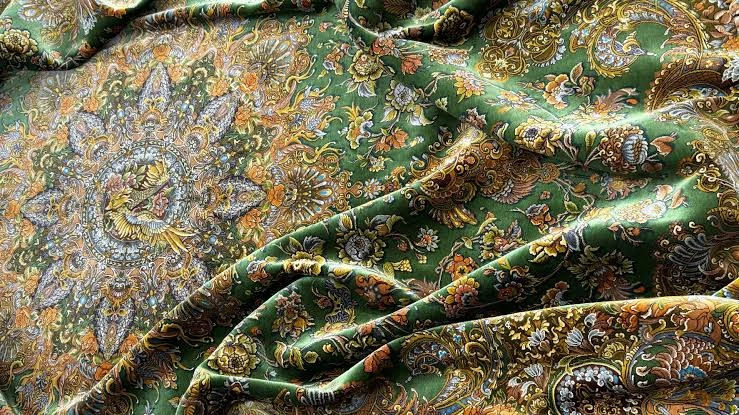
Its microscopic triangular prism structure refracts light rather than merely reflecting it. This natural optical property creates the unmistakable luminous glow that has distinguished genuine silk for centuries.
Why Pure Silk Changes Everything
The greatest difference between wool and silk is not simply texture. It is precision.
Silk fibers are significantly finer than wool, allowing weavers to tie extremely compact knots while maintaining exceptional clarity. This increased precision enables artists to reproduce subtle facial expressions, flowing fabrics, architectural details, and gradual color transitions that would be impossible with thicker fibers.
For this reason, the world's finest Persian portraits and pictorial carpets are frequently woven entirely from silk.
Silk allows the carpet to become a painting without losing its identity as a handwoven textile.
Light as a Design Element
Perhaps the most fascinating characteristic of pure silk is its interaction with light.
A genuine silk carpet never appears exactly the same twice.
As the viewing angle changes, light travels differently across each individual fiber. Colors seem to deepen, brighten, or soften naturally, creating a dynamic visual experience often described as living light.
This optical phenomenon explains why museum visitors frequently pause before silk carpets far longer than before other textiles.
The carpet is not changing.
The light is revealing different dimensions of the weaving.
The Hidden Language of Knot Density
Discussions about silk carpets often focus exclusively on knot density.
Although an exceptionally high knot count allows extraordinary detail, experienced collectors understand that density alone does not determine artistic excellence.
An outstanding silk carpet requires harmony between design, proportion, dye quality, weaving consistency, and artistic interpretation.
A carpet woven with one million perfectly balanced knots may possess greater artistic value than another with a higher knot count but weaker composition.
True excellence is measured by balance, not numbers.
The Science Behind Silk's Longevity
One common misconception is that silk is fragile.
In reality, properly woven and carefully preserved silk carpets can survive for centuries.
Silk proteins possess remarkable tensile strength, while their smooth molecular structure reduces internal friction between fibers. When protected from excessive sunlight, moisture, and improper handling, pure silk remains extraordinarily stable over time.
Many historic Persian silk carpets preserved in museums continue to display exceptional brilliance despite being hundreds of years old.
Their survival is a testament not only to the fiber itself but also to the wisdom of traditional Persian weaving techniques.
Natural Dyes and Silk: A Perfect Partnership
Pure silk responds beautifully to natural dyes.
Traditional Persian dyers understood that silk absorbs pigments differently from wool. This unique relationship allows colors to appear brighter, more transparent, and more luminous while maintaining extraordinary depth.
Madder root produces vibrant reds.
Indigo creates rich blues.
Walnut husks introduce elegant browns.
Pomegranate skins offer warm golden tones.
Together, these natural dyes mature gracefully with age, developing a character impossible to reproduce through synthetic coloration.
The Great Silk-Weaving Centers of Iran
Several historic cities have elevated silk carpet weaving into an internationally respected art form.
Qom
Perhaps the world's most celebrated center for pure silk carpets, Qom is renowned for extraordinary weaving precision, brilliant color palettes, and highly detailed pictorial compositions. Many museum-quality silk carpets originate from its workshops.
Isfahan
Isfahan combines silk with exceptional artistic sophistication. Inspired by Safavid architecture and classical Persian aesthetics, its carpets often demonstrate remarkable balance between elegance and technical mastery.
Kashan
Historically associated with luxury textiles, Kashan has long contributed to the evolution of fine silk weaving, producing carpets admired for their graceful floral compositions and refined craftsmanship.
Tabriz
Although famous for both wool and silk carpets, Tabriz excels in highly detailed pictorial weaving where silk enables remarkable realism and artistic depth.
Recognizing Genuine Pure Silk
Experienced collectors rarely rely on appearance alone.
Authenticity is revealed through multiple characteristics working together.
A genuine pure silk carpet displays natural luminosity rather than artificial shine.
Its fibers remain cool to the touch.
Fine details remain crisp under magnification.
The reverse side reflects the same clarity as the front.
The texture feels smooth without appearing slippery or synthetic.
Most importantly, every knot demonstrates consistency impossible to achieve through machine production.
The finest silk carpets reveal their authenticity quietly.
They never need exaggerated labels to prove their value.
Pure Silk as Cultural Heritage
To understand a pure silk Persian carpet is to understand centuries of accumulated knowledge.
Every carpet represents the collaboration of silk producers, natural dyers, designers, loom builders, and master weavers whose combined expertise transforms raw fiber into enduring art.
Unlike industrial luxury products designed for seasonal markets, a genuine Persian silk carpet is created with future generations in mind.
It is intended to outlive trends.
To become part of a family's history.
To carry cultural memory across centuries.
Beyond Luxury
A pure silk Persian carpet is often admired for its beauty, yet beauty alone cannot explain its enduring significance.
Its true value lies in the convergence of science, craftsmanship, design, history, and human patience.
Every knot records time.
Every color preserves tradition.
Every woven surface reflects centuries of artistic evolution.
To own such a carpet is not simply to possess a luxury object. It is to become a temporary guardian of one of humanity's oldest and most sophisticated artistic traditions.
Silk Pile, Silk Foundation and What “Pure Silk” Should Mean
In the international market, the phrase pure silk Persian rug is sometimes used too loosely. A technically accurate description should distinguish between the pile, warp, and weft. Some carpets use silk only as highlights within a wool pile. Others use a silk pile on a cotton foundation. The most technically demanding examples may use silk pile with silk warp and weft, creating a full silk foundation. These structures behave differently and should not be presented as interchangeable.
The foundation matters because warp tension defines the geometry of the carpet. Fine silk warps can be set very closely, allowing the weaver to create a dense structural grid for minute motifs, calligraphy, faces, architecture, and curvilinear arabesques. Silk wefts can further compress the knot rows and help preserve a thin, flexible handle. However, extreme fineness also makes consistent tension more difficult; a small technical error can distort the drawing across thousands of knots.
For buyers, material claims should be supported by close inspection and, for high-value pieces, specialist testing when necessary. Labels such as “silk-like,” “art silk,” bamboo viscose, rayon, mercerized cotton, and synthetic filament do not describe the same material as natural silk. Visual sheen alone is not sufficient evidence.
Persian and Turkish Knots in Fine Silk Weaving
Fine Persian carpets may use the asymmetrical Persian knot, often called the Senneh knot in English-language rug literature, or the symmetrical Turkish knot, also known as the Ghiordes knot. Neither knot is inherently superior. What matters is how the knot structure serves the design, how evenly the yarn is tensioned, and how the rows interact with the wefts and foundation.
The asymmetrical knot can facilitate very fine curvilinear drawing because one side of the knot wraps fully around a warp while the other passes under the adjacent warp. The symmetrical knot wraps around two warps and can create a compact, robust structure. Regional practice, workshop tradition, and the designer's requirements determine the choice.
Knot count should be measured, not guessed. In Iran, Raj is commonly used in some weaving centres, while international buyers may encounter KPSI or knots per square metre. These systems are not directly interchangeable without knowing both horizontal and vertical knot frequency. A very high density can support detail, but poor drawing, weak colour harmony, or unstable tension cannot be corrected by a large number alone.
Why Design Drafting Becomes More Demanding in Silk
Silk magnifies both skill and error. A thick wool pile can visually soften tiny irregularities; a low, luminous silk pile reveals them. Designers therefore need precise cartoons, balanced proportions, disciplined colour sequencing, and an understanding of how a motif will read after the pile is clipped.
In medallion carpets, small errors in radial symmetry become obvious. In pictorial rugs, the challenge is greater: eyes, fingers, facial outlines, architectural perspective, and calligraphic strokes may be only a few knots wide. The weaver must translate a two-dimensional drawing into a knot grid while maintaining tension and colour accuracy row after row.
This is one reason master-level silk carpets can take years to complete. The labour is not simply the multiplication of knots. It is sustained precision. Every row must align with the design while the whole carpet remains square, the edges remain stable, and the colour transitions remain coherent from a distance.
Colour, Dye Penetration and the Visual Depth of Silk
Silk accepts colour differently from wool because its protein structure, smooth surface, and natural lustre change the way dyed light returns to the eye. Well-dyed silk can appear saturated without looking heavy. Reds may move from ruby to burgundy as the viewing direction changes; blues may shift from bright cobalt to deep navy; ivory and gold can appear almost metallic under grazing light.
Natural dyes can produce exceptionally complex tones, but the phrase “natural dye” should also be used responsibly. Colourfastness depends on dye chemistry, mordanting, water quality, fibre preparation, and washing. Synthetic dyes are not automatically inferior; high-quality modern dyes can be stable and precise. For collectors, the important question is whether the colour system is appropriate to the carpet, stable, harmonious, and honestly described.
Abrash, the subtle change of colour between batches of hand-dyed yarn, is common in many handmade rugs. In a fine silk workshop carpet, abrupt colour changes may be less desirable than in tribal weaving, but gentle tonal variation can still reveal hand production. It should be evaluated within the intended aesthetic rather than treated as a universal defect.
Authentication: How Specialists Examine a Silk Persian Rug
Authentication begins on the reverse. A hand-knotted carpet should reveal individual knots and the structural relationship between warp and weft. Machine-made backing, glued construction, or an applied secondary backing requires different interpretation. Specialists also inspect side finishes, fringe continuity, pile direction, knot irregularity, and the way colours appear through the foundation.
The fibre itself is then assessed. Natural silk has a distinctive combination of lustre, softness, strength, and fine filament structure, but simple home “burn tests” can damage valuable rugs and are not appropriate for collectible textiles. Microscopic examination or professional fibre analysis is safer when the material claim has significant financial consequences.
Signatures and inscriptions should also be interpreted cautiously. A woven name can be meaningful, but a signature alone does not prove authorship, age, or workshop origin. It should be considered alongside design language, structure, materials, provenance, and documented comparison pieces. Strong authentication is cumulative.
Condition, Care and Preventive Conservation
A silk rug can survive for generations, but its greatest enemy is careless friction. High-traffic placement, gritty dust, chair movement, pet claws, and unsuitable vacuum attachments can abrade the pile. Fine silk rugs are best placed where their visual impact is high but mechanical stress is controlled.
Light management is equally important. Prolonged strong sunlight can fade dyes and weaken fibres over time. Curtains, UV-filtering glazing, periodic rotation, and thoughtful placement can reduce uneven exposure. Humidity should remain stable enough to prevent mould, brittleness, and dimensional stress. Water leaks and damp storage are serious risks.
Cleaning should be entrusted to specialists familiar with natural silk and hand-knotted foundations. Excessive alkalinity, aggressive brushing, hot water, uncontrolled bleaching, or strong chemical treatments can change colour, lustre, and handle. For valuable carpets, a condition photograph before cleaning and a written treatment record are good conservation practice.
What Determines the Value of a Fine Silk Persian Carpet?
Material is only one component of value. Buyers and collectors also consider origin, workshop or weaver attribution, knot quality, design, age, condition, rarity, size, colour, provenance, and artistic distinction. A technically dense carpet with ordinary drawing may be less important than a slightly less dense piece with exceptional composition and a documented master-weaver connection.
Qom silk rugs are widely recognized for fine workshop production, but important silk weaving also appears in Isfahan, Kashan, Tabriz, and other centres. Within every city there is a wide quality range. City name should therefore begin the examination, not end it.
For international buyers, documentation has practical value. A clear specification should state dimensions, pile material, foundation material, approximate knot density with method, condition, repairs, origin, signature if present, and available certification. High-resolution images of the front, back, fringe, side cords, and detailed motifs make remote evaluation more credible.
Collecting Pure Silk Rugs with Technical Confidence
The appeal of a pure silk Persian rug lies in the union of fibre science and human discipline. Silk permits an extraordinary density of visual information, but the finest pieces are memorable because that density is controlled by design, colour, proportion, and skilled hands. They reward both close inspection and long viewing.
For collectors searching for a genuine Persian silk rug, the safest approach is to verify structure before accepting labels, judge artistry rather than knot count alone, and preserve the carpet as a textile artwork. A well-documented silk carpet can be a luxury object, a cultural document, and a long-term collectible at the same time.
Workshop Signatures, Inscriptions and Master-Weaver Attribution
Fine silk carpets frequently include woven signatures, workshop names, dedications, dates, poetic inscriptions, or calligraphy. These details can be important, but they need interpretation. A signature may identify a workshop, designer, producer, or person honoured by the commission rather than the individual who tied every knot.
Attribution should therefore combine inscription reading with structural and stylistic analysis. Knot type, warp depression, border drawing, colour palette, silk quality, finishing, and documented comparison examples can support or challenge the name woven into the piece. For high-value carpets, specialist expertise is preferable to relying on a translation alone.
When a signed silk rug is catalogued, the inscription should be photographed at high resolution on both face and reverse where visible. Transcription, translation, and attribution should be recorded separately so later owners can distinguish what is physically woven from what has been interpreted.
Buying a Pure Silk Persian Rug Online: What to Request
Remote purchase requires more evidence because silk is difficult to judge from a single photograph. Request a full frontal image taken square to the carpet, a reverse image, close-ups of the central field and borders, side cords, fringes, and any signature. Photographs from opposite pile directions are particularly useful because genuine silk can change tone dramatically with the nap.
The specification should state whether silk is used in pile, foundation, or highlights; exact dimensions; knot density and measurement method; origin; condition; known repairs; signature; certificate; and shipping terms. If the seller describes a full silk foundation, ask for close reverse details where warp and weft can be examined.
Colour-managed photography is also important. Strong editing can exaggerate saturation and shine. A professional seller should be willing to explain lighting conditions and provide additional images when colour is critical to the purchase.
Displaying Silk Rugs as Collectible Textile Art
Some silk carpets are better treated as low-traffic or display textiles rather than everyday floor coverings. Pictorial pieces, signed workshop rugs, and unusually fine examples may be mounted on a wall or placed in a formal area where abrasion is limited. The decision should depend on condition and intended use, not simply price.
Wall mounting requires conservation-safe support. The carpet's weight should be distributed across a broad area, and metal hooks should not pierce or concentrate stress on a few warp threads. The wall should be dry and the textile should have air circulation behind it. Direct sunlight remains a risk even when the rug is not walked on.
Proper display reveals why silk is valued: changing light, shallow pile, minute drawing, and colour transitions become easier to appreciate when the viewer can approach the textile closely.
Final Technical Note
When comparing silk rugs, insist on precise terminology. “Silk highlights,” “silk pile,” and “full silk foundation” describe different constructions. That distinction should appear consistently in the catalogue, certificate, invoice, and structured product data. Precision protects the buyer and gives proper recognition to the weaver.
Compare Persian Silk Rugs with Complete Product Details
When you are ready to move from research to comparison, browse the Persian silk rug and Qom silk carpet collection. Each rug opens on its own page so you can review dimensions, material, photographs and available commercial information without confusing the educational guide with a product listing.
For a wider comparison across silk and wool weaving centres, visit all authentic Persian rugs for sale. Buyers interested specifically in workshop attribution can continue with our guide to Qom silk carpet makers.