Minimalism, clean architecture, natural materials, and open spaces have become defining elements of contemporary interior design. Yet within these restrained environments, designers often seek a single object capable of adding warmth, character, and cultural depth without disrupting visual harmony. Few decorative elements accomplish this more successfully than an authentic Persian rug.
Far from belonging exclusively to traditional homes, Persian rugs have become an essential feature in many of the world's most sophisticated contemporary interiors. Luxury residences, boutique hotels, art galleries, executive offices, and modern penthouses increasingly incorporate handcrafted Persian carpets as artistic focal points that balance modern simplicity with timeless craftsmanship.
A Persian rug does not compete with contemporary design. It completes it.
Why Modern Interiors Need Handmade Art
Modern architecture frequently emphasizes simplicity.
Concrete, glass, steel, polished stone, and monochromatic color palettes create calm, elegant environments, but they may also feel emotionally restrained.
A handmade Persian rug introduces something these materials cannot provide: human expression.
Every knot reflects the work of an artisan.
Every variation in color tells a story.
Every motif carries centuries of artistic tradition.
Rather than functioning merely as decoration, the rug becomes the element that humanizes the space.
Contrast Creates Sophistication
One of the strongest principles in contemporary design is intentional contrast.
Smooth surfaces become more inviting beside natural textures.
Minimal furnishings gain personality when paired with handcrafted objects.
Neutral interiors acquire depth through carefully selected colors.
Persian rugs achieve this balance naturally.
Their intricate craftsmanship contrasts beautifully with clean architectural lines, allowing each element to enhance the other instead of competing for attention.
The dialogue between modern simplicity and traditional artistry creates interiors that feel both elegant and timeless.
Choosing the Right Rug for Contemporary Homes
Selecting a Persian rug for a modern interior requires more than matching colors.
Professional designers consider proportion, scale, texture, lighting, and architectural rhythm before choosing a carpet.
In contemporary spaces, oversized rugs often establish visual continuity by connecting furniture into a unified composition.
Smaller collectible carpets, on the other hand, can function as independent works of art beneath a coffee table or displayed on a feature wall.
The goal is not to fill space, but to define it.
Color: Harmony Instead of Dominance
Many people assume Persian rugs must always feature strong reds and dark blues.
In reality, Persian weaving traditions include an extraordinary range of subtle palettes.
Soft ivory backgrounds, muted earth tones, elegant greys, warm beige, gentle olive greens, and delicate silk highlights integrate beautifully into minimalist interiors.
Rather than overwhelming the room, these refined palettes introduce quiet sophistication while preserving the architectural clarity of the space.
The Importance of Texture
Contemporary interiors often rely heavily on smooth materials.
Wood flooring, polished concrete, marble, metal, and glass create visual purity but offer limited tactile variation.
A handmade Persian rug introduces an entirely different sensory experience.
Natural wool absorbs sound.
Silk reflects light.
Handwoven textures soften hard surfaces while making rooms feel warmer, calmer, and more inviting.
Texture becomes as important as color.
Persian Rugs as Functional Art
Unlike paintings that remain fixed on a wall, Persian rugs are artworks designed to live with people.
They transform dining rooms, bedrooms, libraries, offices, entrance halls, and living spaces without losing their artistic identity.
In many contemporary homes, collectible rugs are also displayed vertically as textile art, allowing viewers to appreciate every detail while preserving the carpet from daily wear.
This dual identity, as both artwork and functional object, distinguishes Persian rugs from nearly every other decorative element.
Integrating Persian Rugs Room by Room
Living Room
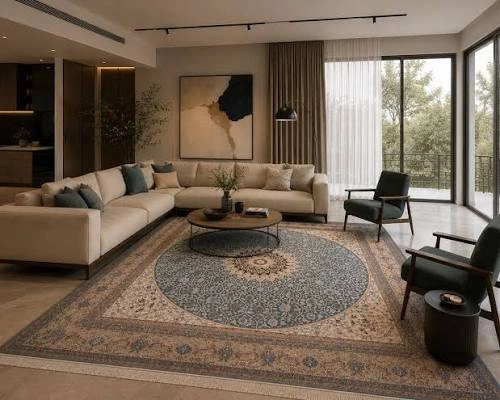
A large Persian rug anchors seating arrangements, defines conversation areas, and introduces warmth into open-plan interiors.
Dining Room
Choosing a rug larger than the dining table ensures visual balance while protecting flooring and adding elegance to formal gatherings.
Bedroom
A handwoven carpet introduces softness, acoustic comfort, and visual tranquility, making the bedroom feel more intimate and luxurious.
Home Office
Persian rugs add authority, character, and refinement to professional workspaces, creating an environment that reflects both taste and cultural appreciation.
Entrance Hall
The entrance establishes the first impression of a home.
A carefully selected Persian rug immediately communicates authenticity, craftsmanship, and timeless elegance.
Sustainability Through Longevity
Contemporary design increasingly values sustainability over disposable consumption.
Authentic Persian rugs represent one of the earliest examples of sustainable luxury.
Handwoven from natural fibers, colored with traditional dyes, and built to last for generations, they stand in direct contrast to mass-produced furnishings designed for short life cycles.
Rather than replacing a Persian rug every few years, families often preserve it for decades or even centuries.
Its beauty evolves instead of fading.
More Than Decoration
Interior designers often speak about creating spaces with personality.
Furniture provides function.
Lighting creates atmosphere.
Architecture establishes structure.
But it is art that gives a home its identity.
A Persian rug accomplishes this without demanding attention.
Its presence is quiet yet unmistakable.
It connects contemporary living with centuries of artistic heritage, reminding us that innovation and tradition need not exist in opposition.
The finest interiors are not those filled with expensive objects.
They are the ones where every object has meaning.
An authentic Persian rug offers exactly that: a timeless work of art capable of enriching modern spaces while preserving one of the world's greatest cultural traditions.
Scale and Proportion: The First Design Decision
In a contemporary room, the wrong rug size can make even an exceptional carpet feel accidental. The first decision is therefore architectural rather than decorative. Measure the seating zone, circulation paths, door clearances, and the relationship between the rug and fixed elements such as fireplaces, kitchen islands, glazing, or built-in cabinetry.
For a living room, a large Persian rug can unify the entire seating composition by allowing the main furniture to sit fully or partly on the rug. In a smaller room, leaving a controlled border of visible flooring can create visual breathing space. A rug that is too small often fragments the room, while an oversized rug can suppress the architecture if every edge disappears under furniture.
Dining rooms require enough perimeter beyond the table for chairs to remain on the rug when pulled back. Bedrooms can use one large carpet under the bed or smaller rugs positioned to create soft landing areas. In corridors, runners should respect door swings and maintain a deliberate margin from the walls.
Building a Contemporary Colour Palette Around a Persian Rug
A Persian rug contains multiple colours, but a modern interior does not need to repeat all of them. Designers often select one dominant architectural neutral, one secondary tone from the rug, and a restrained accent colour. This allows the carpet to remain visually rich without forcing every cushion, curtain, or artwork to match it.
Warm ivory, stone, plaster, oak, walnut, brushed metal, and textured linen can provide quiet backgrounds for detailed Persian designs. Deep navy, madder red, pistachio green, saffron, turquoise, or aubergine may then be echoed selectively in upholstery, ceramics, glass, or art. The strongest rooms use colour relationships rather than exact duplication.
Lighting changes the palette dramatically. Natural wool absorbs and diffuses light, while silk highlights can appear brighter or darker as the viewing direction changes. Before committing to wall paint or fabrics, examine the rug during morning, midday, and evening light. A carpet that looks cool beside north-facing windows may appear warmer under low-temperature artificial lighting.
Pattern Balance: Let One Element Lead
Contemporary interiors can combine pattern successfully, but hierarchy matters. If the Persian rug is highly detailed, surrounding surfaces usually benefit from simpler textures or larger-scale patterns. If the rug has an open field or restrained medallion, bolder artwork or upholstery can coexist without visual competition.
Pattern scale should vary. A densely patterned carpet, a medium-scale woven textile, and a large abstract artwork can occupy the same room because they operate at different visual frequencies. Problems arise when several elements compete with similar motif size and colour intensity.
This principle is especially useful with floral Kerman carpets, curvilinear Kashan or Isfahan designs, geometric Heriz rugs, and pictorial pieces. Each has a different visual rhythm. A geometric rug may strengthen a minimalist interior with angular furniture, while a floral carpet can soften rectilinear architecture and introduce movement.
Material Dialogue: Wool, Silk, Timber, Stone and Metal
The best modern interiors are tactile. Persian rugs contribute a surface that responds to timber, stone, concrete, leather, glass, and metal in different ways. A dense wool pile can soften polished concrete and reduce acoustic hardness. A fine silk rug can add controlled luminosity near matte plaster or dark timber. A low-pile antique carpet can introduce visual history without creating excessive physical volume.
Material contrast should feel intentional. Brushed brass beside a warm madder palette can create a quiet sense of continuity, while blackened steel can sharpen the geometry of a Heriz or Bijar design. Pale oak and linen often work well with ivory-ground carpets, and darker walnut can anchor rugs with deep blue, burgundy, or brown fields.
Texture also affects perceived luxury. A room composed only of smooth new surfaces can feel anonymous even when expensive. Hand-knotted wool, visible abrash, hand-finished edges, and subtle irregularity introduce evidence of making. This is why an authentic Persian rug can give a contemporary interior emotional depth without making it look traditional.
Using Persian Rugs to Zone Open-Plan Spaces
Open-plan architecture often needs visual boundaries without physical partitions. Rugs are one of the most effective tools for creating these zones. A large carpet can define the main conversation area, a runner can direct circulation, and a smaller collectible piece can identify a reading or music corner.
For adjoining zones, the rugs do not need to match. They should, however, relate through one or two shared qualities: colour temperature, age, material, border scale, or design intensity. Two highly dominant rugs placed too close together can compete, while one strong carpet paired with a quieter companion often creates a more sophisticated rhythm.
In lofts and large apartments, leaving deliberate areas of exposed floor between rugs helps each piece read as an independent artwork. In smaller spaces, overlapping should be used carefully because it can obscure edges, trap dust, and complicate maintenance. Clear placement usually looks more architectural.
Pictorial and Collectible Rugs as Wall Art
Not every Persian carpet needs to be placed under furniture. Fine pictorial rugs, signed workshop pieces, silk carpets, and fragile antique textiles can be displayed vertically when their structure and condition permit. This approach treats the rug as textile art and can protect it from foot traffic.
Wall mounting must distribute weight evenly. Nails or narrow pressure points can damage warps and side cords. Conservation-grade mounting systems, sleeves, or professional textile supports are preferable for valuable pieces. Air circulation behind the rug and protection from damp walls are also important.
When hung properly, a Persian rug can function like a large painting while offering far more surface texture. In minimalist interiors, one important textile can replace a gallery wall and create a focal point with cultural and material depth.
Authenticity Matters More in Minimal Spaces
Minimal interiors expose quality. With fewer objects in the room, the construction of each piece becomes easier to see. A hand-knotted Persian rug therefore benefits from close inspection: individual knots on the reverse, natural variation in pile, hand-finished sides, tonal abrash, and subtle asymmetry can all contribute to authenticity.
Machine-made reproductions can imitate motifs but usually lack the structural complexity and irregular rhythm of hand weaving. For buyers selecting an authentic Persian rug for a modern interior, material, origin, knot structure, condition, and seller documentation should be considered alongside colour and style.
This is also where provenance adds design value. Knowing that a rug was woven in Tabriz, Kerman, Kashan, Qom, Isfahan, or a specific village tradition changes the way the object is understood. The carpet becomes part of the room's narrative rather than an anonymous patterned surface.
Practical Care in Contemporary Homes
Modern homes introduce specific risks: large areas of glazing, underfloor heating, robotic vacuum cleaners, rolling office chairs, and heavy modular furniture. A valuable Persian rug should be placed with these conditions in mind. Strong sunlight may require UV control or periodic rotation, while aggressive vacuum brushes can abrade delicate pile and fringes.
A high-quality underlay improves comfort, reduces movement, and can help distribute pressure. Furniture cups may be useful under concentrated loads. Spills should be blotted promptly rather than rubbed, and professional cleaning should be selected according to fibre and dye type. Silk rugs require greater caution than robust wool carpets.
Good care supports both appearance and long-term value. A rug that is correctly placed, cleaned, and documented can remain part of a changing interior for decades, moving from one room or generation to another without losing its identity.
Why Persian Rugs Continue to Work in Contemporary Design
The enduring success of Persian rugs in contemporary interiors comes from contrast and compatibility at the same time. They contrast with industrial surfaces through handwork, texture, and irregularity, yet they are compatible with modern architecture because their proportions, colour systems, and visual hierarchy can be used with discipline.
A strong interior does not disguise the carpet's origin or force it to imitate current trends. It allows the rug to remain visibly Persian while giving it enough space, light, and material contrast to be read clearly. That approach produces rooms that feel current without becoming temporary.
Room-by-Room Placement Guide
In living rooms, place the rug according to the furniture grouping rather than the room perimeter. A generous carpet can support all major seating pieces; a slightly smaller one can sit under the front legs of sofas and chairs. What matters is consistency. Randomly placing only one furniture leg on the rug creates visual instability.
In dining rooms, choose a rug large enough for chairs to remain on the pile when occupied and moved. Low to medium pile is often practical because chair legs move more easily and crumbs can be cleaned. In bedrooms, a soft wool rug can extend around the bed, while a finer collectible rug may be placed at the foot where traffic is lighter.
Home offices need special attention to rolling chairs. Repeated caster movement can abrade pile and distort fringes, so valuable rugs should either sit outside the chair path or be protected with appropriate furniture planning. In entrance halls, durable wool rugs and runners generally perform better than delicate silk pieces.
Antique, Vintage or New Persian Rug in a Modern Home?
Antique rugs often bring softened colour, low pile, and historical character that work beautifully with contemporary furniture. Vintage pieces can provide a similar sense of age with a broader range of prices and conditions. New hand-knotted rugs offer cleaner condition, stronger pile, and more predictable dimensions while still preserving traditional technique.
The choice should reflect lifestyle. A household with children, pets, or heavy traffic may prefer resilient wool and a condition that allows responsible daily use. A collector may choose a finer silk or antique piece for a protected room. Modern styling does not require artificially distressed rugs; authentic age and honest newness can both be attractive when used deliberately.
Condition should always be disclosed. Repairs, low pile, colour variation, and replaced fringes may be acceptable, but they should be understood before placement and maintenance decisions are made.
Designer Checklist Before Final Placement
Photograph the empty room, mark the proposed rug dimensions with low-tack tape, and verify circulation before purchasing. Check how doors open, where direct sunlight falls, and whether heavy furniture will create concentrated pressure. Record the rug's pile direction because colour may change depending on the direction from which it is viewed.
Then evaluate the room at three distances: close enough to see fibre and detail, mid-range where border and field interact, and far enough to judge the rug as part of the whole architecture. A Persian carpet should succeed at all three scales.
Finally, document the placement. Keep photographs, invoice, dimensions, origin, materials, and care instructions. Good interior design and good collecting practice reinforce each other when the rug is treated as both a functional textile and a work of art.
Persian Rugs in Apartments, Hotels and Commercial Interiors
Persian rugs can also work effectively outside private houses. In apartments, a single well-scaled carpet can define the main living zone without permanent architectural changes. Boutique hotels, executive offices, galleries, and reception spaces can use hand-knotted rugs to add identity to otherwise standardized interiors.
Commercial placement requires more attention to traffic, cleaning schedules, accessibility, and insurance. Robust wool rugs are generally more suitable for busy circulation than delicate silk carpets. Valuable pieces should be positioned away from entrance moisture, wheeled equipment, and repeated furniture movement.
When specified professionally, a Persian rug can give a hospitality or corporate interior a sense of place and permanence that printed surface decoration cannot reproduce.
Final Styling Principle
The most successful rooms do not use a Persian rug as a theme. They use it as a serious material and artistic element. Give the carpet enough space to be read, repeat its colours selectively, protect it from avoidable damage, and allow the rest of the interior to remain contemporary. The contrast is the strength.